June 14, 2026
How to Make a Picture Round for Your Pub Quiz
The picture round is one of those moments in the night when the whole room goes quiet and leans over the table. Teams squint, point, argue in whispers - and that hush is exactly the effect you want. A well-made picture round gives everyone a break from read-aloud questions and works just as well for people who don't fare so well by ear.
This guide walks you through the whole thing: where to find images without landing in legal trouble, how to prepare and print them so they actually read, how much time to give teams, and which ideas land best. All of it from the point of view of someone who has put these rounds together dozens of times.
What a picture round actually is
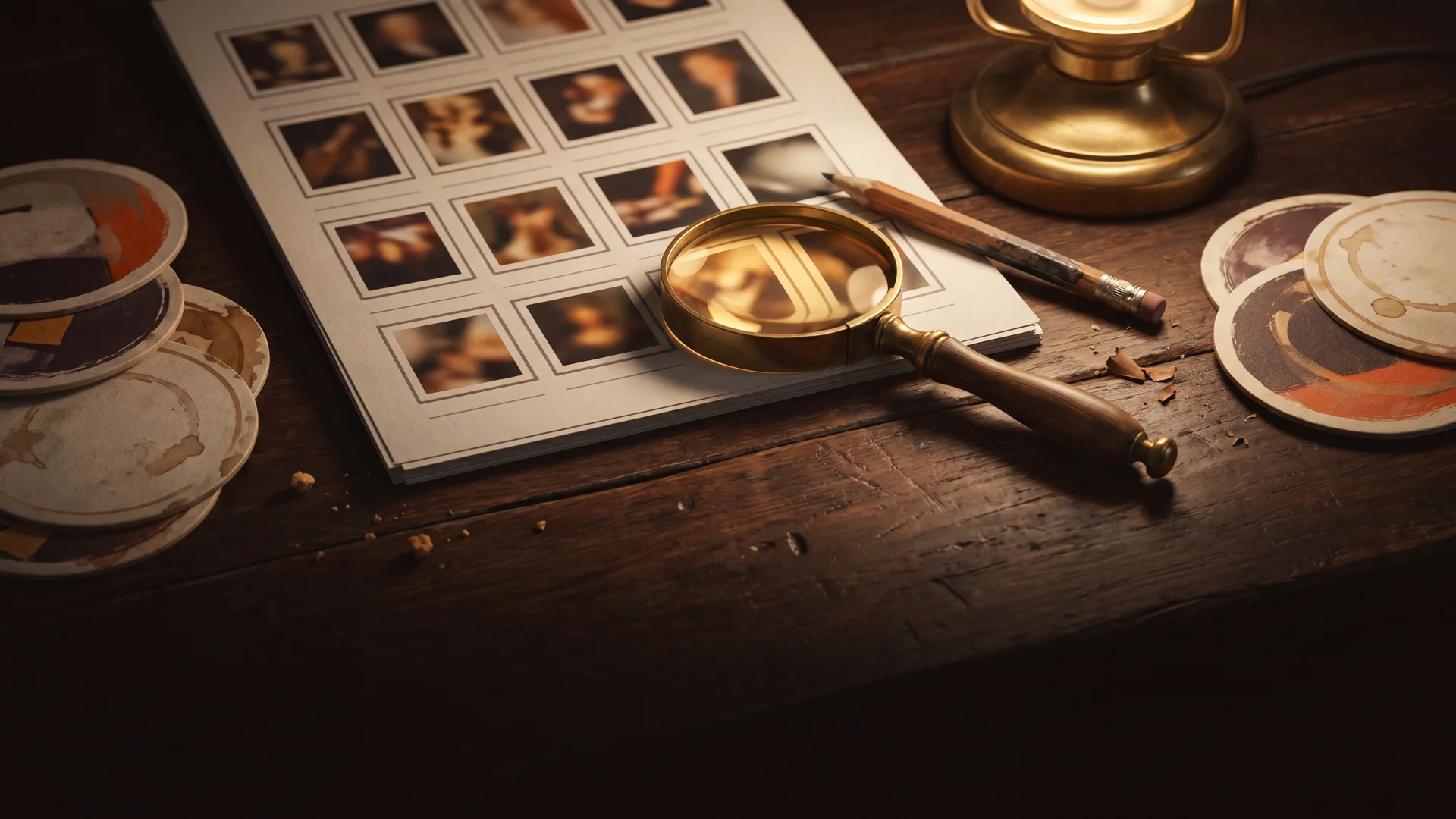
In its simplest form, it's a sheet of numbered images - usually somewhere between ten and twenty - and the team's job is to identify what or who is in each one. It might be a famous face, a brand logo, a flag, a film still, or an extreme close-up of an everyday object. Teams write their guesses next to the numbers on a separate answer sheet, and you collect and mark them just like any other round.
The strength of the format is that it's visual and self-contained. You don't read anything aloud, teams work at their own pace, and the sheet stays on the table as proof - nobody can claim they misheard the question. It's also a natural breather between your louder, more intense rounds.
Step 1: pick a theme and difficulty
Before you start gathering images, decide what the round is about and who it's for. A tight theme - say, all flags or all car logos - reads better than a random mix and is easier to introduce. If you prefer variety, keep a common thread, even something broad like "pop culture".
Control difficulty through the specific images you choose, not through the theme itself. Three easy, a handful of medium, and two genuinely hard at the end is a good spread. Put the toughest ones at the bottom of the sheet so teams bank some certain points first and don't get discouraged out of the gate.
Step 2: where to source images legally
This is the part that's easiest to wave away and quickest to cause trouble. Grabbing the first image off a Google search is a gamble - most of those pictures are copyrighted. For one night down the pub nobody is likely to complain, but if you do this regularly, sell tickets, or publish your sheets online, it pays to do it properly.
The safest sources are openly licensed material. Wikimedia Commons holds enormous collections of buildings, flags, animals, and places, each file clearly labelled with its licence and how to credit the author. Stock sites like Unsplash, Pexels, and Pixabay offer free-to-use photos, though you'll rarely find recognisable faces or specific products there. National flags are in the public domain, so you have a free hand with those.
Brand logos are their own case. They can be trademarks in themselves, but showing a logo for identification in a quiz usually sits within fair use - you're not implying the brand sponsors you, nor selling their goods. Even so, I wouldn't publish that sheet online. Treat film stills and celebrity faces the same way: they play brilliantly in the room, but keep them as in-house material for the night rather than something for wide distribution.
If you'd rather skip the nuance entirely, the simplest route is to build rounds from images you clearly have the right to use, or to lean on ready-made packs - there's more on what goes into a well-run night in what you need for a pub quiz.
Step 3: prepare the images for print
Legibility is everything here. An image that looks great on a laptop screen can turn into a grey smudge once it's printed on a black-and-white printer in the pub. A few rules that will save you grief:
- Resolution. Aim for images at least 800 to 1000 pixels wide per tile. Tiny web thumbnails fall apart into pixel mush when enlarged.
- Contrast. If you're printing in black and white, check the image still makes sense without colour. The flags of Poland and Indonesia look almost identical in greyscale - catch traps like that early.
- Cropping. Crop tight to keep only what matters for the question. Spare background just distracts and shrinks the recognisable element.
- Numbering. Every image needs a clear number beside or beneath it. Teams must know without hesitation which item their answer belongs to.
The most convenient layout is a grid - one A4 sheet comfortably holds six to nine images if they're going to be clearly visible. With twenty items, spread them across two pages rather than cramming everything onto one. A team is better off with two readable sheets than one where nothing can be made out.
Step 4: timing and running the round
A picture round runs to a different rhythm than a read-aloud round. Here you're not dictating questions - you're handing out sheets and keeping time. For ten images, five to seven minutes is usually plenty; for twenty, give eight to ten. It's better for teams to feel a gentle clock than to sit bored.
Hand out the picture sheets and the answer sheets together, announce the theme and the time, then leave teams to it. It's worth calling out one minute to go - that's usually the moment someone suddenly remembers. Make sure phones stay face down on the table; the picture round is uniquely easy to cheat at with reverse image search, so the host's vigilance matters more here than anywhere.
When you mark and reveal answers, you can put the images up on a screen or simply read out the correct names against the numbers. If you have a projector, showing the image alongside the answer gives that satisfying "oh, of course!" moment around the room.
Proven picture round ideas
Once you've got the mechanics down, the best part is left - dreaming up themes. Here are formats that reliably land:
- Brand logos. Cut the symbol away from the name. Car badges, fast-food chains, and sports teams give a wide range of difficulty.
- National flags. A classic with an endless supply of harder examples. Mix the obvious with the obscure so nobody sweeps the lot.
- Film stills. A single, distinctive scene without the lead actors' faces can be surprisingly hard and very satisfying once revealed.
- Extreme close-ups. A macro shot of an everyday thing - a zip, a slice of lemon, the texture of a strawberry. The brain stumbles first, then suddenly sees it.
- Famous landmarks. Recognisable buildings and monuments, ideally from an unusual angle. The Eiffel Tower from below looks nothing like the postcard.
If you want to weave more of these unusual formats into the night, have a look at unusual quiz round ideas for the full range. And if the picture round suits you, the natural next step is the music round, which works on similar logic: a break from reading and a strong impression in the room.
Common mistakes worth avoiding
The first is images that are too small. If a team at the back of the room has to stand up to see anything, the round is lost. The second is no balance - twenty very hard items frustrate, while twenty very easy ones bore. The third is ignoring the black-and-white version; not every pub has a colour printer, so design so it works either way.
One more thing: always prepare a spare image or two. There's always an item that turns out either too obvious or impossible, and it's good to have something to swap it for at the last minute.
FAQ
How many images should a picture round have?
Ten to twenty is the sweet spot. Ten makes a quick, snappy round; twenty fills a larger block of the night. Below ten, the round ends before teams warm up; above twenty, it starts to drag.
Can I use Google images in my pub quiz?
For a private night down the pub, nothing usually comes of it, but most search-engine images are copyrighted. If you charge admission or publish your sheets online, use openly licensed material (Wikimedia Commons, Unsplash) or ready-made, vetted packs instead.
How big should the images be on a printable sheet?
A readable A4 sheet comfortably holds six to nine images. Each tile should be at least 800 pixels wide in the source. With more items, spread them across two pages rather than shrinking everything down.
How do I stop cheating in a picture round?
This is the round most exposed to reverse image search, so ask for phones face down on the table and keep an eye on the room. A shorter time limit helps too - under pressure it's harder to search discreetly.
Build the whole pack without the manual work
Putting a picture round together from scratch can be enjoyable, but it can also eat your whole evening - especially once you're checking sources and wrestling with print sizing too. Don't want to write questions by hand? Build the whole pack in RoundKit - free, in 5 minutes. Head to the builder and have a full quiz night ready before your coffee goes cold.