June 14, 2026
How to Run a Charity Quiz Night That Raises Real Money
A charity quiz has one huge advantage over a plain collection tin: people don't give out of obligation, they give because they're having a brilliant time. An evening of questions, laughter and table-by-table rivalry opens wallets all on its own. The skill is turning that good energy into a real sum for a cause you care about, and doing it so nobody feels squeezed.
Below is the full plan: how people pay to get in, the clever ways to gather extra during the evening, and the warm hosting that makes guests want to come back next year.
Start with the cause, then everything else
Before you count a single penny, name the cause clearly. "We're raising money" is too vague. "We're raising money for new equipment for the youth club" is concrete, and concrete moves people. The more tangible and local the cause, the harder your guests will lean in. If you can show exactly what the money buys, and what one specific thing costs, you give the whole evening a natural reference point for every amount you ask for.
Decide too who the beneficiary is and how the money reaches them. That shapes both guest trust and how you describe the event in your invitations. Transparency is your best currency. People give more freely when they know the total genuinely lands where it's meant to.
Entry: tickets and entry fees as the foundation
Your base stream is the cost of taking part. There are two popular approaches, and they work well combined.
A fee per team. You set a fixed amount per table, say for a team of up to six. It's simple to run and naturally nudges people to fill a full table. The more heads per table, the cheaper it is each, and you still collect more across the room.
A donation per person. Each player gives a suggested amount on the door, with the freedom to give more. Framing it as a donation rather than a ticket reminds everyone the money is for the cause, not for an evening out.
In practice a hybrid works best: a base table fee plus the option to give more on top. Sell entry in advance whenever you can. Pre-sales lock in a guaranteed sum before the night even starts and let you estimate turnout. If you're new to the format itself, the guide on how to host your first pub quiz covers the mechanics. Most of the evening is the same; you're just adding a fundraising layer on top.
Between-round mini-fundraisers: where the total grows
The entry fee alone rarely makes an impressive number. The real magic happens in the gaps between rounds, when the room is warm and in a good mood. A few proven mechanisms:
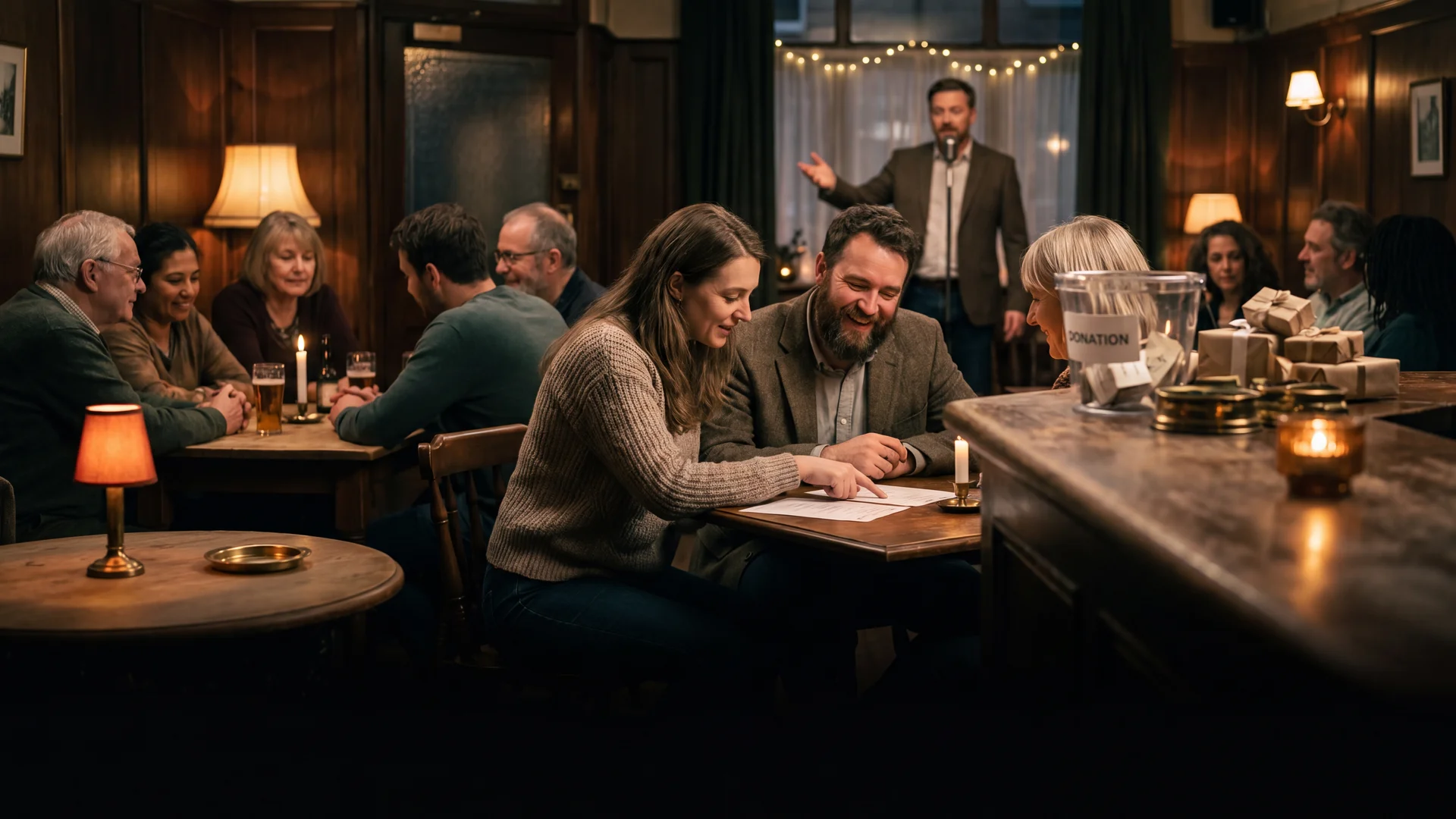
A raffle. Sell tickets through the evening and draw prizes in a break: a bottle of wine, a voucher from a local partner, a hamper. It's a classic because the spend is small and the draw is exciting. Ask nearby businesses for prizes. Most will happily hand over something in exchange for a shout-out from the stage.
Mulligans (hints for a donation). Sell teams "lifelines": for a small amount they get one wrong answer crossed off, an extra thirty seconds, or a single hint. Teams who badly want to win buy them without hesitation, and you get a steady trickle of small donations.
A surprise "buy a point" round. Once in the evening, announce that for a set donation a team gets a bonus point. It's light, a bit cheeky, and it wakes the room up, while competitive teams take it deadly seriously.
A jar-guessing game. A jar of sweets, a bottle of coins, or guess the weight of a cake. Closest guess wins. Each guess costs a small amount and the guessing runs all night.
Spread these out. Don't fire everything at once. One item after each round keeps the pace up without wearing people down. The same balancing instinct applies here as in any good evening: alternate the type of activity so nobody gets bored, much like the mix you'd aim for with team building trivia questions.
Auctions: the finishing touch
If you have one or two genuinely desirable items - a weekend away, a piece by a local artist, a meal at a good restaurant - run a short live auction near the end. This is often the single biggest cash injection of the whole night.
An auction needs energy. You want a confident host who can build the excitement, and a few willing souls in the room ready to bid early so the price gets moving. Keep it short: two or three lots at most, a few minutes each. A long auction kills the momentum of the evening.
A lighter option to run is a silent auction: lay out the items with bidding sheets, let guests write their offers throughout the evening, and the highest bid wins at close. Less drama, but it doesn't demand the whole room's attention all at once.
A word on the legal side - briefly and carefully
This is not legal advice, just a flag that it's worth checking before you start. There's an important difference between a private, closed event and a public collection or lottery aimed at the general public.
A ticketed evening for invited guests, where you charge for entry or sell donations within a known group, is usually a different situation from an open, widely advertised collection aimed at anyone. Public collections and raffles can fall under their own rules and obligations, depending on scale and the value of the prize pool, and these vary by country and region.
What that means for you in practice: before you advertise the event widely to the public, or plan a sizeable raffle or lottery, check the current rules for your area or speak to someone who knows them. If you're raising money through an existing charity or organisation, lean on their procedures. They'll have this sorted. It's far better to ask the question up front than to untangle it afterwards. Treat this section as a reminder, not a ready-made answer for your specific situation.
How to host it warmly
The charitable purpose changes the tone of your hosting. Yes, there's rivalry, but the shared cause sits front and centre, and your guests should feel that.
- Say what you're raising for, at the start. Briefly, concretely, with heart. If you have someone connected to the cause, give them two minutes. Authenticity does more than any host's punchline.
- Thank people during, not just at the end. After each mini-fundraiser, announce how much you've raised so far. A rising counter drives the next round of giving better than any appeal.
- Don't push. Every extra - tickets, hints, the auction - should be an invitation, never pressure. People who are enjoying themselves freely will give more anyway.
- Close with thanks and a number. Share the total raised, even a rough one, and remind everyone who it helps. That's what sticks, and it's what brings them back.
Sort out your turnout well ahead too. An empty room won't raise much for even the best cause. For practical ways to fill the seats, see how to promote a quiz night. The more tables you have, the bigger the pool across everything: entry, the raffle and the auction.
How much can you realistically raise
There's no single figure, but there is a simple logic. Your result is the sum of a few streams: entry (a predictable base), the mini-fundraisers during the night (often as much as entry, and frequently more when the evening is run well), and the auction (a one-off but large boost if you have desirable lots). So don't lean your whole result on tickets alone. That "during the night" layer is exactly what separates a decent evening from a genuinely successful fundraiser.
One small thing that makes a real difference: offer several ways to pay. Plenty of guests carry no cash, and a missing card or instant-transfer option is a donation that simply never happens.
FAQ
Should I charge per team or take a donation per person?
Combine both. A base table fee gives you a predictable foundation and encourages people to fill full teams, while a voluntary donation lets more generous guests give extra without embarrassing anyone on a tighter budget. Selling entry in advance also guarantees you part of the sum before the night begins.
What raises the most money beyond entry fees?
Usually the mini-fundraisers spread through the evening: a raffle, hints for a donation, and guessing games. Each spend is small, but they add up across the night. If you have one genuinely desirable item, a short live auction can be the single biggest result of the evening.
Do I need permission or to register to run a charity quiz?
It depends on the scale and nature of the event. A closed event for invited guests is different from a public collection or a large raffle. This isn't legal advice: before you advertise widely or plan a big prize pool, check the current rules for your area, or lean on the procedures of the charity you're working with.
How do I prepare the questions without spending all week on it?
Questions are the part that eats time most easily. You can write them yourself, but a ready-made, balanced set of rounds saves hours and gives you confidence the difficulty is even across the night. That frees your energy for the fundraising layer, which is what really decides how the evening performs.
Don't want to write questions by hand? Build the whole pack in RoundKit - free, in 5 minutes. You focus on the cause and your guests, and the host material, answer sheets and a complete quiz night are ready to go.