June 14, 2026
How to Score a Pub Quiz - Fast, Fair Marking Systems
Scoring is the moment a good quiz night can quietly fall apart. The questions were sharp, the room was buzzing, and then the host spends twenty minutes hunched over a pile of answer sheets while the crowd starts to grumble. The good news: a simple scoring system plus one trick - swapping sheets between teams - solves this for good, and that is what this article is about.
The golden rule: scoring should be boring
It sounds backwards, but this is the single most useful idea here. The simpler your scoring, the less room there is for mistakes, arguments and delays. Teams came to compete and enjoy the questions, not to admire your clever weighting algorithm. Every extra rule is one more thing to explain at the start, one more place to miscount, and one more reason for someone to dispute the result.
So the starting point is always the same: 1 point for a correct answer, 0 for a wrong or blank one. No negative marks, no fractions, no speed bonuses. You build special rounds on top of that foundation only if you genuinely want to spice up the night.
The classic system: one point per question
This is the absolute standard for a pub quiz, and it works because everyone understands it without being told. Five rounds of ten questions gives fifty points up for grabs - a round number that is easy to total in your head. If you have not settled your structure yet, start with the guide on how many rounds and questions a pub quiz needs before you worry about marking.
A few decisions worth making up front and announcing before you start:
- Spelling: ignore mistakes if the answer is unmistakable. "Napolean Bonaparte" is still Napoleon. Say this at the top so nobody hopes to dock a rival on a stray letter.
- Partial answers: for a two-part question ("name the river and its length"), decide in advance whether you give half a point or run "all or nothing". Half points slow the counting down - I recommend all or nothing.
- Open versus closed questions: with A/B/C/D options there are no arguments. With open questions ("what is the name of...") expect debate, so keep a list of accepted variants ready.
Most importantly: record scores round by round, not all at the end. After each round you collect the sheets, mark them, write the totals into a master table, and hand the sheets back. By the finish you already have almost the full total, instead of a stack of fifty questions to wade through at once.
Special rounds: when they are worth it and how to score them
Special rounds are seasoning, not the main course. One per night, two at most - any more and the room loses track of the rules. Here are three reliable mechanics:
Double points
The safest of the special rounds. You pick one round - usually the second to last, for tension - where every question is worth 2 points instead of 1. It does not change the counting logic, only the multiplier, so mistakes are unlikely. The effect: a team near the back gets a real chance to claw back ground, and the finish becomes genuinely exciting. Announce it before the round, not after, or it is unfair.
Jackpot (escalating points)
Here you introduce a pot of points that grows with difficulty. The classic layout: in a themed round the early questions are easy (1 point) and the last ones are worth 3 to 5 points because they are much harder. You can also run an "all or nothing" variant: one very hard question worth 5 points at the end of the round, where a team gambles on whether it knows the answer. The jackpot rewards knowledge of niche detail and can flip the leaderboard at the last second - so use it sparingly, because it rewards risk more than consistency.
Wipeout (negative marks)
The riskiest mechanic, with negative scoring. In a wipeout round a wrong answer is not 0 but -1, so a team has to decide whether to answer at all. That turns the round into a psychological game: are we sure enough to risk it? Be warned: negative marks complicate the counting and can frustrate newer teams. Use wipeout in one round only, ideally with a crowd that already knows the format. For a first quiz, skip it.
| System | Points | Why | Risk |
|---|---|---|---|
| Classic | 1 pt / question | Simple, everyone gets it | None - this is the base |
| Double points | 2 pt / question in 1 round | Tension at the finish | Minimal |
| Jackpot | 3-5 pt for hard questions | Rewards real knowledge | Can flip the leaderboard |
| Wipeout | -1 for a wrong answer | Psychological game | Frustration, counting errors |
Self-marking: swapping sheets between teams
This is the trick that lets hosts finish the night without a headache. Instead of marking fifty sheets yourself, you hand the job to the room. The mechanic is dead simple:
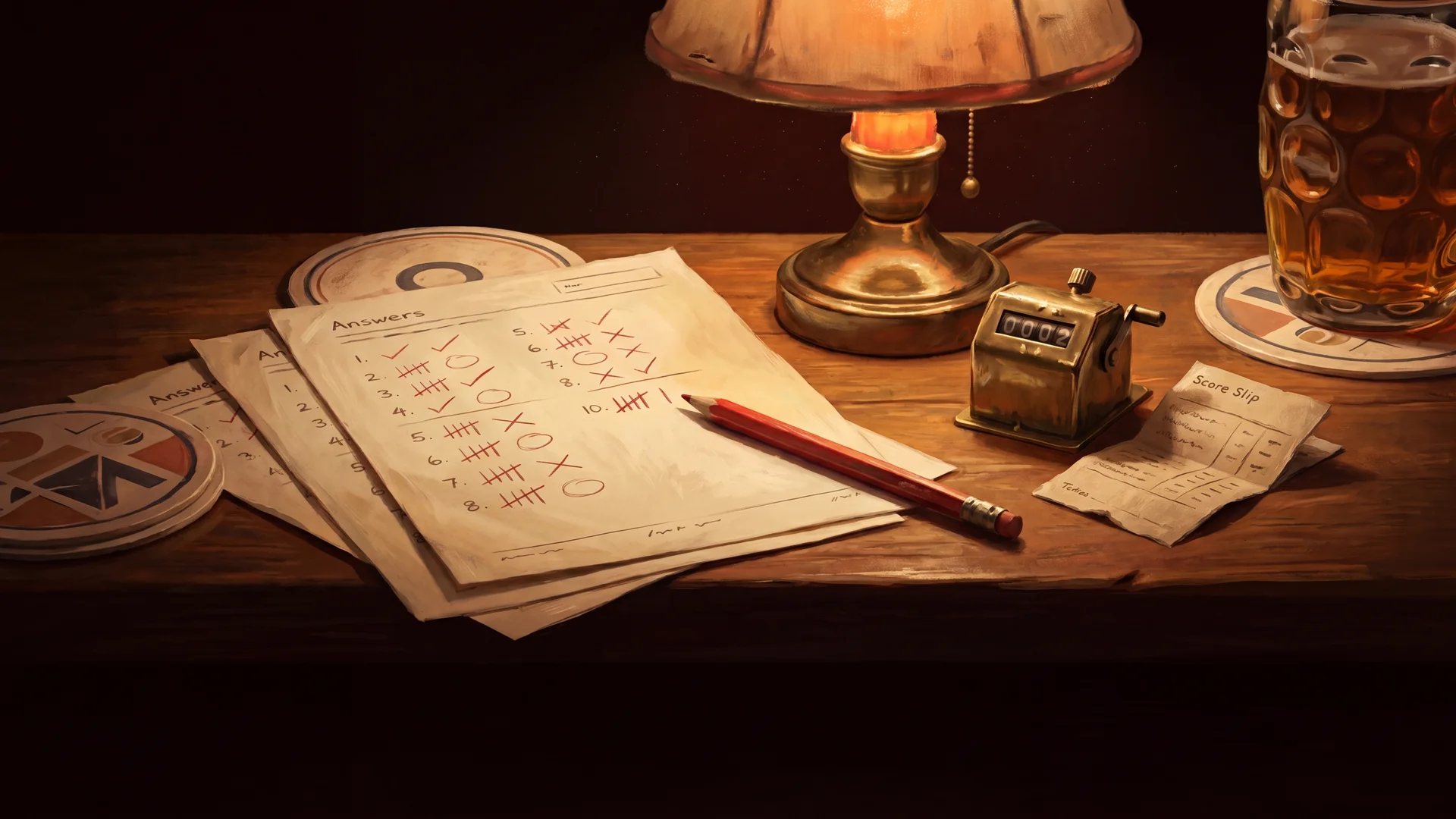
- After a round each team passes its sheet on and receives another team's (pass to the left - it is easy to make sure nobody marks their own).
- You read out the correct answers, teams tick the correct ones on the sheet in front of them and add up the total.
- Teams return the sheets with the score written on, and you simply copy the totals into your master table.
The upsides: counting goes about five times faster because the whole room does it at once, and cheating becomes almost impossible - nobody marks their own answers and the entire room hears the correct options read aloud. For this to run smoothly the sheets need to be legible, with clear boxes for answers and a box for the round score. If you are designing your own, see the guide on the pub quiz answer sheet template - a good sheet is half the battle for self-marking.
One safety rule: the final round, and especially any round that decides the win, you mark yourself. When first place is on the line, you do not want a rival counting a rival's points.
How to handle disputed answers
Disputes will always happen - it is part of the fun. The skill is settling them quickly and consistently before they grow into a row. A few rules worth announcing at the top of the night:
- The host has the final say. Say it plainly at the start: "On disputed answers, my decision is final." That is not tyranny - it saves everyone time and nerves.
- Meaning counts, not form. If an answer clearly points to the right thing, you accept it despite a typo or a colloquial name. "USA" and "the United States" are the same.
- When in doubt, favour the team - but consistently. If you accept a variant once, you must accept it for every team that wrote it. That is why you should mark all sheets for the same question together.
- Appeals only right after the round. A team can raise a dispute while you read out that round's answers - not half an hour later when the sheets are already circulating.
A small trick: if a question turns out to be ambiguous and several teams are right in different ways, the fairest move is to void the question and not score it for anyone. Better to lose one question than your credibility. And if you end up tied at the top, do not improvise - prepare in advance by reading about pub quiz tie breaker questions.
FAQ
Should I use negative marks?
Only deliberately, and only in a wipeout round, if the group enjoys that kind of risk. For an average night and less experienced teams, negative marks complicate the counting and frustrate more than they thrill. By default, stick with 0 for a wrong answer.
How do I total scores quickly with lots of teams?
Swapping sheets and self-marking after each round is the best answer with eight or more teams. The whole room counts in parallel and you only copy the totals across. Keep a master table updated round by round so there is nothing left to add up at the end.
Can I change the scoring during the night?
Do not change rules you have already announced - it is the fastest way to lose the room's trust. Always announce special rounds and their values before that round, never after. The only exception is voiding a faulty question, since that works equally in everyone's favour.
One point per question or points by difficulty?
Start with one point per question - it is clear and fair. Varying the value (jackpot) is an extra for later, once you have some practice and want to heighten the drama in a single round. Do not build the whole night on it.
Don't want to write questions by hand or fiddle with marking grids? Build the whole pack in RoundKit - with print-ready answer sheets made for self-marking - free, in 5 minutes.